
What Is F&I Training? What You Actually Learn in F&I School
What Is F&I Training? What You Actually Learn in F&I School
Bottom line: F&I training teaches students how the finance and insurance department of a car dealership works. A comprehensive F&I program should cover automotive credit, lender relationships, deal structuring, financing, F&I products, documentation, compliance, and customer presentation.
F&I stands for Finance and Insurance.
At a car dealership, the F&I department plays a central role in completing the financial portion of a vehicle purchase.
Because the job involves much more than filling out paperwork, aspiring F&I managers need to understand credit, lenders, financing, contracts, customer communication, and dealership procedures.
That is what F&I training is designed to teach.
What Is F&I Training?
F&I training is specialized automotive finance education designed to teach students how dealership finance departments operate.
Rather than providing a broad education in general finance, F&I training focuses specifically on the skills used during automotive retail transactions.
Students may learn how to:
- Review customer credit
- Understand lender programs
- Structure vehicle finance deals
- Submit financing
- Interpret lender decisions
- Complete finance documents
- Present F&I products
- Follow compliance procedures
- Communicate financing options to customers
The objective is to help students understand the complete finance process from the point a customer purchases a vehicle through the completion of the transaction.
What Does F&I Stand For?
F&I stands for Finance and Insurance.
The finance portion generally relates to vehicle financing, lenders, credit, contracts, and loan structure.
The insurance or protection-product side can involve optional products offered through the dealership's F&I department.
Although the name is short, the responsibilities of an F&I manager cover many different areas.
What Do You Learn in F&I School?
A comprehensive F&I training program should teach both the technical and customer-facing sides of automotive finance.
Here are some of the most important subjects.
1. Automotive Credit
One of the first things an F&I student needs to understand is credit.
Automotive lenders use credit information to evaluate financing applications.
Students should learn how to interpret information such as:
- Credit scores
- Payment history
- Auto-loan history
- Revolving debt
- Installment loans
- Delinquencies
- Collections
- Credit inquiries
- Overall credit profile
The purpose is not simply to identify a credit score.
An F&I manager must understand how the customer's broader financial profile may influence lender options and deal structure.
2. Prime and Subprime Financing
F&I training should also explain how different credit profiles may affect automotive financing.
Prime and subprime are broad terms commonly used when discussing customer credit and lending risk.
However, different lenders have different programs.
That means an F&I professional needs to understand both the customer and the lender.
A customer may qualify differently depending on the lender, vehicle, amount financed, down payment, and structure of the transaction.
3. Automotive Lenders
A dealership may work with several different financial institutions.
These can include:
- Banks
- Credit unions
- Manufacturer finance companies
- Specialized auto lenders
- Other financial institutions
F&I students need to understand how dealership-lender relationships work.
That can include learning:
- Which types of deals a lender may consider
- How financing applications are submitted
- How lender decisions are reviewed
- What approval conditions may mean
- What documentation lenders may require
Knowing how to work effectively with lenders is one of the most important responsibilities of an F&I manager.
4. Deal Structuring
Deal structuring is a fundamental part of F&I training.
A vehicle transaction may include:
- Vehicle selling price
- Trade-in value
- Existing trade payoff
- Customer down payment
- Credit profile
- Vehicle value
- Amount financed
- Loan term
- Interest rate
- Lender requirements
These variables influence one another.
F&I students should learn how to evaluate a transaction as a complete financial structure rather than looking at each number independently.
5. Financing Applications and Approvals
Students should also learn how the financing process works between the dealership and lender.
Depending on the dealership and lender, the process may involve:
- Gathering customer information
- Reviewing credit
- Selecting appropriate lenders
- Submitting the financing application
- Receiving a lender decision
- Reviewing approval terms or conditions
- Adjusting the deal if necessary
- Completing required documentation
Understanding this process helps students see how credit, lenders, and deal structure work together.
6. F&I Products
F&I managers may present optional products that provide financial or vehicle protection.
Depending on the dealership, these may include:
- Vehicle service contracts
- GAP protection
- Maintenance plans
- Tire and wheel protection
- Appearance protection
- Other optional protection products
F&I training should teach students what these products are and how to explain them clearly.
Students should understand the product before learning how to present it.
7. F&I Menu Presentation
Many dealerships use a structured presentation process to show customers available F&I options.
Students may learn how to communicate these choices clearly and professionally.
Effective F&I presentation is not simply about reading a list of products.
The finance manager should be able to:
- Explain the customer's options
- Answer questions
- Describe product benefits and limitations
- Communicate costs
- Help the customer understand what is optional
- Maintain a professional customer experience
8. F&I Compliance
Compliance should be a major component of F&I training.
Finance managers work with sensitive customer information and regulated financial transactions.
Students should learn the importance of accurate documentation, disclosures, customer privacy, consistent procedures, and dealership compliance standards.
A professional F&I manager needs to understand both how to complete a deal and how to complete it properly.
9. Finance Documentation
A vehicle purchase can generate significant paperwork.
F&I students may learn how different dealership and lender documents fit into a transaction.
That can include understanding the purpose of:
- Finance contracts
- Customer agreements
- Lender documents
- Product agreements
- Disclosures
- Supporting documentation
Accuracy is especially important because errors can delay funding or create other problems within the transaction.
10. Customer Communication
F&I managers deal directly with customers.
That makes communication a fundamental skill.
Customers may ask questions such as:
- Why is my interest rate different than expected?
- Why does the lender require a down payment?
- What does GAP protection do?
- What is included in a service contract?
- How long is my loan?
- What is my total amount financed?
A well-trained F&I manager should be able to explain these topics without overwhelming the customer with dealership terminology.
Is F&I Training Just Sales Training?
No.
Sales skills can be important in F&I because finance managers present products and communicate with customers.
However, F&I is much broader than sales.
A complete training program should also cover:
- Finance
- Credit
- Lenders
- Contracts
- Documentation
- Compliance
- Deal structuring
- Customer communication
A program that focuses only on selling F&I products would leave out major parts of the actual job.
Is F&I Training the Same as Automotive Sales Training?
No.
Automotive sales training generally focuses on the vehicle sales process.
F&I training focuses on what happens primarily after the customer has decided to purchase a vehicle.
A salesperson may help the customer choose and negotiate the vehicle.
The F&I manager then becomes involved in the financing, lender, documentation, and protection-product portions of the transaction.
Who Should Consider F&I Training?
F&I education may be appropriate for people interested in automotive finance careers, including:
- Dealership sales professionals seeking advancement
- People entering the automotive industry
- Banking professionals
- Lending professionals
- Insurance professionals
- Finance professionals
- Veterans transitioning into civilian careers
- Customer-service professionals
- People interested in performance-based dealership careers
Previous dealership experience can help, but specialized training may also provide an entry point for students who are new to automotive retail.
Do You Need Dealership Experience Before F&I School?
Not necessarily.
A student can learn F&I concepts without having previously worked at a dealership.
In fact, structured training can help beginners understand dealership terminology and processes before pursuing employment.
Read our guide on How to Become an F&I Manager With No Dealership Experience for a detailed explanation of this career path.
How Is F&I Training Different From Learning on the Job?
Learning on the job can provide valuable real-world experience.
However, dealership employees may learn different processes depending on the dealership, manager, and available opportunities.
Formal F&I training provides a structured environment in which students can learn multiple components of the job together.
Instead of learning one task at a time, students can see how:
credit → lenders → deal structure → financing → products → documentation → compliance
connect inside one automotive transaction.
What Should You Look for in an F&I School?
Before choosing an F&I training program, look closely at what is actually taught.
A comprehensive program should provide education in areas such as:
- Automotive credit
- Prime and subprime financing
- Lender relationships
- Deal structuring
- Finance applications
- F&I products
- Customer presentation
- Documentation
- Compliance
- Realistic dealership scenarios
Students should leave with an understanding of the complete role—not just isolated terminology.
What Is the Goal of F&I Training?
The goal of F&I training is to prepare students to better understand and perform the responsibilities associated with an automotive finance department.
Students should learn how to evaluate the financial side of a vehicle transaction, communicate with lenders and customers, complete documentation, understand F&I products, and follow appropriate procedures.
Ultimately, F&I education is career preparation for one of the most specialized roles inside an automotive dealership.
Learn F&I at Automotive Dealership Institute
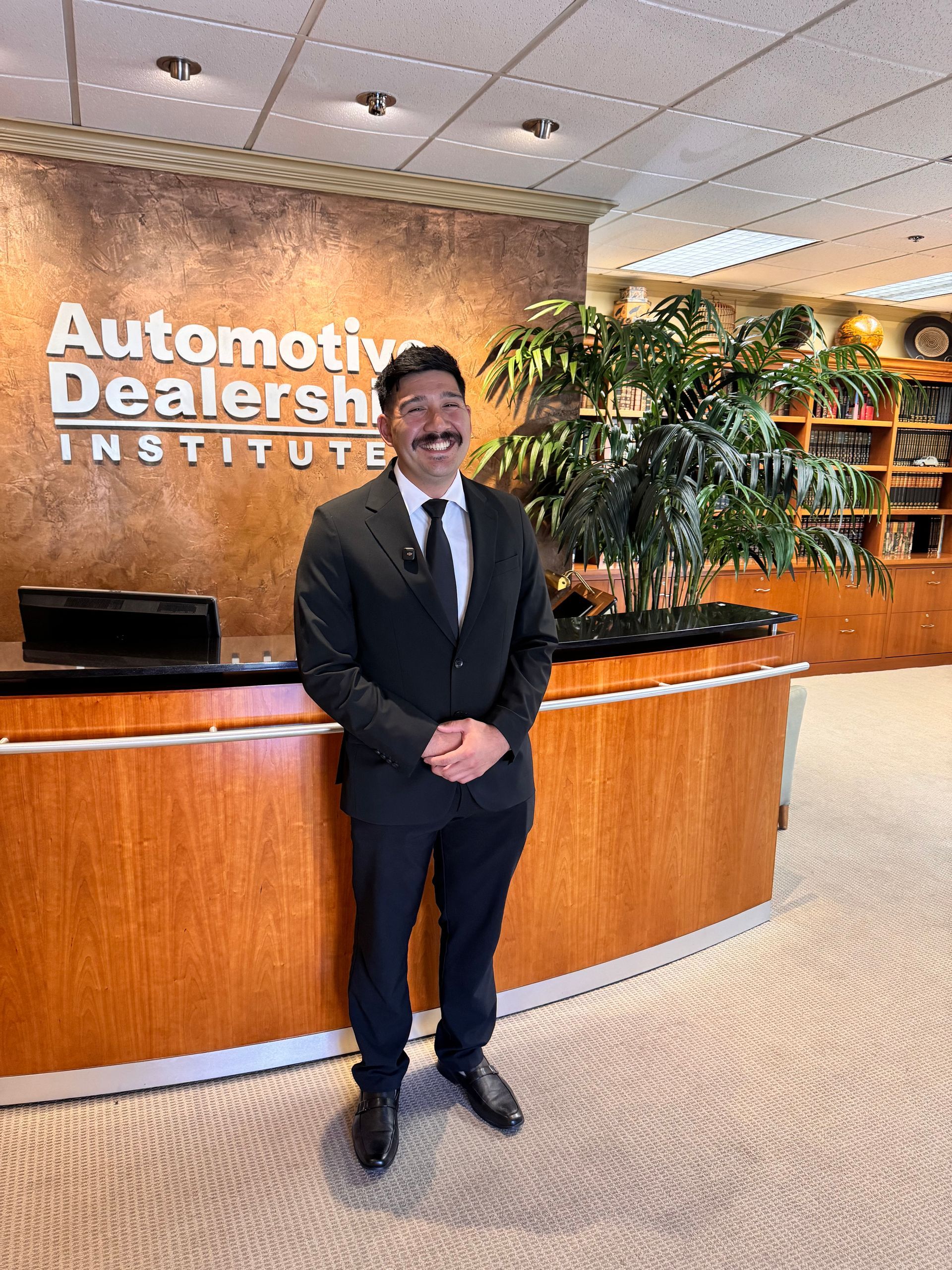
Automotive Dealership Institute provides specialized education for students pursuing careers in automotive finance and insurance.
Students receive training in the concepts used inside dealership F&I departments, including automotive credit, lenders, deal structuring, financing, F&I products, documentation, compliance, and customer communication.
Whether you already work in automotive retail or are exploring a new career, F&I training can help you develop dealership-specific finance knowledge.
Explore Automotive Dealership Institute's F&I Manager Training Program.
Frequently Asked Questions About F&I Training
What does F&I training teach?
F&I training typically covers automotive credit, lenders, financing, deal structuring, F&I products, documentation, compliance, and customer presentation.
What does F&I stand for?
F&I stands for Finance and Insurance.
Do you need experience to attend F&I school?
Not necessarily. Some students already work in automotive retail, while others may enter training from finance, lending, insurance, sales, military, or other professional backgrounds.
Is F&I training only about selling warranties?
No. A complete F&I program should cover much more than product sales, including credit, lenders, finance applications, deal structuring, documentation, compliance, and customer communication.
What skills do F&I managers learn?
F&I managers need skills in automotive finance, credit analysis, lender relationships, deal structuring, communication, product presentation, documentation, and compliance.
Is F&I training useful for someone new to the automotive industry?
Yes. Structured F&I education can help beginners understand dealership finance terminology, procedures, and responsibilities before pursuing automotive finance positions.
Where can I learn automotive F&I?
Automotive Dealership Institute provides specialized F&I manager training for students interested in automotive dealership finance careers.